Entanglement as Reproducible Correlations of a Shared Field State

Updated: Apr 11
Abstract
Quantum entanglement is frequently portrayed in popular explanations as "direct influence at a distance," evoking images of instantaneous interactions between separated particles. However, experimental practice reveals a fundamentally different picture: entanglement is not a signaling mechanism but a reproducible pattern of correlations between local measurement outcomes that defies explanation by models relying solely on local, predetermined properties.
This essay adopts a strictly operational approach, first detailing how entanglement is prepared, measured, and certified in modern quantum experiments, using methods such as Bell/CHSH tests, tomography, entanglement witnesses, spin squeezing, continuous variables, and device-independent certification, while explicitly addressing assumptions and known vulnerabilities. It then reinterprets these measurement practices through a zero-point field framework, where "field" is understood not as a local value F(X,t) but as a shared state with intrinsic correlation structure.
Within this framework, entanglement is reformulated as:
equal preparation + equal measurement context ⇒ same correlation functionswith local outcomes remaining uncontrollable (no signaling). The essay concludes by proposing a testing agenda to operationalize the notion of "exactly the same conditions" and explores potential extensions to cosmological modeling (e.g., GLV layer L7), emphasizing their speculative rather than empirical status.
1. Introduction
The concept of quantum entanglement has long captivated both scientists and the public, often framed as "spooky action at a distance", a phrase that suggests particles influence each other instantaneously across vast separations. While this metaphor captures the counterintuitive nature of entanglement, it obscures its true operational meaning.
In experimental quantum physics, entanglement manifests not as a mysterious connection but as a statistical relationship between measurement outcomes that cannot be replicated by any theory relying on local hidden variables or classical shared randomness. The confusion surrounding entanglement typically stems not from experimental data but from the interpretive frameworks used to explain it. Classical intuition, rooted in the idea of independent objects with fixed properties, struggles to accommodate the nonlocal correlations observed in quantum systems. Instead, the field of quantum information theory treats entanglement as a resource characterized by the nonseparability of a joint quantum state, a property that is mathematically precise and experimentally verifiable.
This essay bridges the gap between abstract theory and concrete measurement by adopting a twofold approach. First, it surveys the operational tools used to detect and certify entanglement, from foundational Bell tests to advanced techniques like device-independent protocols. These methods collectively demonstrate that entanglement is not about "control at a distance" but about correlations that violate classical bounds while respecting the no-signaling principle. Second, it reframes these findings within a zero-point field perspective, where the field is treated as a state with embedded correlations rather than a collection of local values. This shift aligns with the methodological principles of GLV 2.0, particularly relational minimalism (where quantities derive meaning from their context) and modular verifiability (where theoretical claims must be empirically testable). By operationalizing key concepts like "exactly the same conditions," the essay clarifies how entanglement arises from shared preparation and measurement contexts, without implying any hidden causal mechanisms.
Finally, the discussion extends to cosmological implications, such as the speculative GLV layer L7, which proposes that entanglement entropy could influence large-scale structures like gravitational lensing. However, such extensions are presented not as established facts but as testable hypotheses, grounding speculative ideas in the same operational rigor that defines modern quantum experiments. The goal is to move beyond interpretive debates and toward a unified, empirically grounded understanding of entanglement as a fundamental feature of quantum states.
2. Operational Definition: What Entanglement Is (and Is Not)
2.1 Nonseparability as the Core
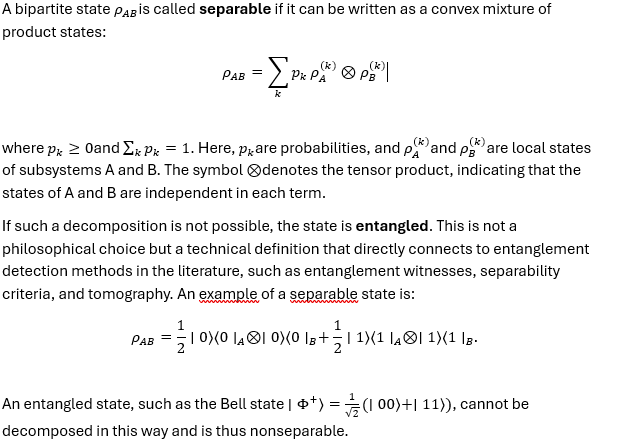
2.2 Correlation Is Not the Same as Control
Entanglement implies that joint statistics cannot be reduced to local "states" + classical shared noise, but it does not imply that local outcomes are controllable. This distinction is structurally embedded in the no-signaling character of quantum correlations: local marginal distributions remain unchanged by choices or outcomes elsewhere, as long as no classical communication is used. The distinction between "correlation" and "control" is precisely what Bell tests experimentally exploit: correlation is measured, not signal transfer.
2.3 Bell Nonlocality and Entanglement Are Related but Not Identical
A Bell violation rules out a broad class of local realistic explanations, but not every entangled state violates a Bell inequality under every measurement setting. This is standard material in the review literature on nonlocality.
3. How Entanglement Is Measured in Practice
All methods below follow the same structure:
What is measured?
What certifies entanglement?
Assumptions and vulnerabilities
Zero-point field (ZPF) interpretation
ZPF risk or distinguishing feature (where can it deviate?)
3.1 Bell and CHSH Tests
What is measured?
Per trial: two measurement settings (e.g., basis choices) and two outcomes (e.g., ±1); after many trials: correlations and a CHSH combination .
What certifies entanglement?
A CHSH violation (S>2) rules out local realistic models and certifies nonclassical correlations; in many standard setups, this also implies entanglement of the source. A CHSH violation certifies Bell-nonlocal correlations; within quantum theory this implies entanglement of the shared state.
Assumptions and vulnerabilities
Historically: detection loophole, locality loophole, freedom of choice/measurement independence, timing/coincidence selection. Modern "loophole-free" experiments are designed to simultaneously close the dominant loopholes.
ZPF interpretation
In a zero-point field approach, a Bell violation is interpreted as: the correlation structure of the shared field state is not reducible to two local field values plus classical hidden variables. The test does not measure "instantaneous influence" but the impossibility of explaining the data with a factorizable model.
ZPF risk or distinguishing feature
A correct ZPF interpretation must explicitly preserve no signaling; any formulation suggesting local outcome control directly conflicts with the architecture of Bell tests (which explicitly exclude signaling routes).
3.2 Loophole-Free Bell Tests (Practical Standard)
What is measured?
As in 3.1, but with spacetime separation of settings/outcomes and detection efficiency high enough to avoid assuming "fair sampling."
What certifies entanglement?
Statistically significant Bell violation, reported on multiple platforms. A well-known experiment is that of Hensen et al. with electron spins in diamond, separated by ~1.3 km. For photons, loophole-free results have been reported by Shalm et al. and Giustina et al.
Assumptions and vulnerabilities
While not every conceivable metaphysical alternative (such as superdeterminism) can be experimentally excluded, the major technical loopholes are simultaneously addressed in this setup.
ZPF interpretation
This type of experiment supports a minimalist reading: "one shared state, two local measurements, zero signals." ZPF does not need to incorporate anything "faster than light"; it explains correlation as a property of the shared state.
ZPF risk or distinguishing feature
If ZPF wants to be more than reinterpretation, it must indicate where deviations are expected in such experiments (e.g., context-dependent corrections to correlation functions or scale/noise dependence that does not align with standard decoherence models). Without such specification, it remains interpretive.
3.3 Quantum State Tomography
What is measured?
A complete set of measurements in multiple bases, so that a density matrix can be reconstructed from frequencies (linear or maximum likelihood).
What certifies entanglement?
After reconstruction: entanglement measures (e.g., negativity) or separability criteria applied to .
Assumptions and vulnerabilities
i.i.d. (identical preparation per trial), measurement calibration, finite sample bias, and reconstruction artifacts; maximum likelihood reconstruction is used to enforce physical p.
ZPF interpretation
Tomography directly fits "field as state": the object being reconstructed is not a local field value F(x) , but the state (with coherences and correlations) that generates the measurement statistics.
ZPF risk or distinguishing feature
ZPF must explicitly define what "same conditions" means in tomography: same preparation channel + same measurement POVMs + same postselection rules. This is an operationalization, not a metaphor.
3.4 Entanglement Witnesses
What is measured?
A limited set of observables (often linear combinations) designed to detect entanglement with few measurement settings.
What certifies entanglement?
A witness W is chosen such that

for all separable states, and

for at least one class of entangled states.
Assumptions and vulnerabilities
Witnesses are usually not device-independent: trust in the measurement model (what is being measured) and calibration is required.
ZPF interpretation
In ZPF terms, a witness measures a directed projection of the correlation structure of the field state; entanglement is then a property of the state, not of local "field values."
ZPF risk or distinguishing feature
Because witnesses are model-dependent, they provide a weak basis for claiming new ZPF effects. They are primarily suitable for efficiently determining "is there entanglement?"
3.5 Spin Squeezing and Entanglement Depth (Multipartite Systems)
What is measured?
Collective spin components and variances in ensembles (atoms/ions/spins); typically, not the full microstate is measured, but global quantities.
What certifies entanglement?
Spin squeezing inequalities can demonstrate multipartite entanglement and even derive a minimal "entanglement depth."
Assumptions and vulnerabilities
Symmetry assumptions, calibration of collective measurement, decoherence due to environmental coupling.
ZPF interpretation
This is conceptually important: "entanglement in complex systems" in practice often means entanglement of a collective mode, not of all internal degrees of freedom. In ZPF terms: one coherent substructure in the field state carries the correlation; the rest mainly acts as a decoherence bath.
ZPF risk or distinguishing feature
A ZPF claim must avoid suggesting that "the entire object" is entangled; the measurement practice itself points to effective subspaces, aligning with standard decoherence theory.
3.6 Continuous Variable Entanglement (Optics)
What is measured?
Quadratures of light fields via homodyne detection; measurement outcomes are continuous.
What certifies entanglement?
Inseparability criteria such as those of Duan et al.; for Gaussian states, the criterion is necessary and sufficient.
Assumptions and vulnerabilities
Detector linearity, shot noise calibration, (sometimes) Gaussian model assumption for stricter conclusions.
ZPF interpretation
Continuous variables are didactically useful for correcting the "field misunderstanding": quadratures are measurement outcomes of a state, not "the true field value at a point." ZPF can directly embrace this by treating "field" primarily as a state.
ZPF risk or distinguishing feature
Precisely because CV systems sound "field-like," this is the context where one most quickly reverts to thinking of field as a function. The essay must therefore explicitly enforce the semantic shift.
3.7 Device-Independent Certification, Self-Testing, DI QKD, and Randomness
What is measured?
As with Bell: settings and outcomes. The difference is that no detailed internal device model is trusted; the conclusion is drawn from correlations alone.
What certifies entanglement/quantum properties?
Bell violation can serve as device-independent evidence for entanglement and as a basis for randomness certification. A classic example is "random numbers certified by Bell’s theorem."
Device-independent cryptography (such as DI QKD) bases security on Bell correlations; early security results were formulated by Acín et al. (collective attacks) and further developed in later security proofs.
Assumptions and vulnerabilities
For DI claims, unwanted communication channels between devices must be excluded; additionally, there are assumptions about setting randomness and (depending on the proof) independence between trials.
ZPF interpretation
Device-independent frameworks are the "hard arena" for any field state interpretation: only the correlation structure matters. This fits well with ZPF, provided the theory formulates correlations without implicit signaling mechanisms.
ZPF risk or distinguishing feature
If ZPF adds a physical substructure, it must either behave exactly no signaling or directly conflict with DI security/logic. The DI framework thus serves as a natural consistency test.
4. Quantum Networks: Entanglement as Infrastructure
Quantum networks are conceptually useful because they practically dismantle the "action at a distance" framework: entanglement is created, swapped, distributed, and often "polished" with classical feedback.
4.1 Entanglement Swapping
Żukowski et al. introduced the "event-ready" swapping idea: systems that never directly interacted can still become entangled via suitable measurements on their partners.
4.2 Nonlocal Correlations from Swapping and Bilocality
Branciard et al. characterize the nonlocal correlations that arise via swapping and compare network correlations with bilocal models.
4.3 Quantum Repeaters
Briegel et al. describe quantum repeaters with nested purification to circumvent exponential loss with distance.
4.4 Long-Distance Distribution (Satellite)
Yin et al. reported satellite-based distribution of entangled photons to two ground stations separated by ~1203 km.
ZPF reading of networks: In practice, distance mainly affects loss and decoherence, not a "delay" of correlation. This supports the interpretation "correlation without control" and simultaneously reveals where engineering degrades the correlations.
5. Complex and Macroscopic Systems
That entanglement can also occur experimentally with larger systems is now well documented, provided coherence is maintained in the relevant (usually collective) degrees of freedom.
Ockeloen-Korppi et al. demonstrated stabilized entanglement of two micromechanical oscillators (each ~10^12 atoms) via a cavity architecture.
Lee et al. reported entanglement between vibrational states of two spatially separated, millimeter-sized diamonds at room temperature.
The theoretical baseline for understanding why this is fragile is decoherence: environmental coupling selects pointer states and suppresses interference between macroscopic superpositions. Zurek’s review is a standard reference here.
ZPF implication: "Macroscopic entanglement" rarely means entanglement of "all internal details," but rather of a controlled effective subspace (collective mode), in line with both measurement practice (spin squeezing-like witnesses) and decoherence theory.
6. Zero-Point Field Interpretation: From Field Value to Field State
6.1 The Core Shift: Field as Function vs. Field as State
The persistent communication error in many discussions is that "field" is automatically read as a local field function F(x,t): one value per point. For entanglement, this is usually the wrong intuition. Entanglement is a property of the state (with coherences and correlations) and manifests itself in correlation functions, witnesses, and reconstructions.
In zero-point field terms, the core claim is therefore not "a field instantaneously sends something elsewhere," but: The shared field state is not separable; local measurements sample that structure.
In this essay, ‘field state’ denotes the operationally reconstructed joint quantum state (density operator) and its correlation structure; the ZPF language is an interpretive layer, not an additional signalling mechanism.
6.2 "Exactly the Same Conditions" as Operational Equivalence
A scientifically useful formulation of "exactly the same conditions" requires explicit components:
Preparation: same preparation procedure of the joint state (same source/channel).
Measurement context: same measurement settings (basis choice), calibration, timing rules.
Selection: same coincidence/postselection criteria (or explicitly no selection).
Channel noise/decoherence: comparable loss and noise parameters.
Within this definition, the central theorem becomes:Under operationally equivalent preparation and measurement context, the correlation functions are reproducible, even when individual outcomes remain locally random.
This formulation is directly compatible with what Bell tests, tomography, and witnesses actually do.
The nontrivial content is that ‘distance’ enters primarily through loss/decoherence parameters, not as a causal propagation delay in the correlation law.
6.3 Relational Minimalism as a Conceptual Bridge
GLV 2.0 explicitly formulates that distances and time durations gain meaning relative to a reference (in cosmology: the light path), and that measurement-relative interpretations must be exhausted before new entities are introduced.
In the entanglement domain, the analogy is: outcomes gain meaning relative to the measurement context (basis/settings) and the shared state; a projection to "two separate local objects" is a representational choice that easily leads to incorrect causal intuition.
6.4 On Cosmological Translation (GLV Layer L7)
GLV 2.0 introduces as a speculative module L7 "Quantum Entanglement Lens Modulation": an information-theoretically motivated correction in which entanglement entropy would provide a large-scale correction to lensing power and predicts specific signatures (e.g., low l parity asymmetry and a squeezed bispectrum signature).
In a strictly scientific construction, this comes only after the operational measurement basis: L7 is then not "proof" for ZPF but a hypothesis that only has meaning if an explicit bridge law is given from entanglement quantities (operationally defined) to lensing observables. The modular character ("tool, not dogma") is an explicit part of the GLV architecture.
7. Testing Agenda and Possible Distinguishing Arenas
7.1 Hardest Consistency Requirement: No Signaling
Any zero-point field interpretation that wants to reformulate entanglement must preserve no signaling and thus avoid implicitly introducing "outcome control." This is not optional; it follows from the structure of Bell tests and the device-independent literature.
7.2 Device-Independent Benchmarks as a Calibration Point
Because DI certification centers correlations and minimizes internal device models, this is the natural arena to test whether ZPF formulations are "clean" (no hidden signaling assumptions).
7.3 Decoherence Scaling Laws and Macroscopicity
A potential distinguishing route is not "distance" but the precise way in which correlations degrade under environmental coupling (decoherence). Standard theory is strong, so a ZPF deviation must be quantitatively sharp (different scaling law, extra noise channel, context dependence).
7.4 Gravity as a Test Arena (Quantum Gravity Witness)
There are proposals to test whether gravity itself must have quantum properties by asking whether gravity can mediate entanglement. Marletto and Vedral formulate this as an information-theoretic witness: if two masses become entangled via gravity, then the mediating "field" must have at least two noncommuting observables (thus not purely classical).
For a zero-point field framework that wants to connect relativity and quantum, this is a principled relevant direction: it shifts the discussion from interpretation to testable dynamics.
addendum candidate deviations...
8. Conclusion
Entanglement is not a mysterious distance mechanism in measurement practice but a fundamental property of quantum states that manifests as nonclassical correlations between local measurements. Bell tests (including loophole-free variants), tomography, entanglement witnesses, spin squeezing, continuous variable criteria, and device-independent protocols together form a robust operational basis.
The zero-point field interpretation proposed here unifies this practice by treating "field" primarily as a field state with a correlation structure and by operationalizing "exactly the same conditions" as equivalence of preparation, measurement context, and selection rules. In this reading, entanglement becomes:
equal preparation + equal measurement context ⇒ same correlation functions
without local outcomes ever becoming directly controllable.
Possible cosmological extensions (such as GLV layer L7) can then be positioned methodologically in the same spirit: as modular, testable hypotheses with explicit parameters and predicted observables, not as rhetorical "post hoc explanations."
References (Selection)
Brunner, N., Cavalcanti, D., Pironio, S., Scarani, V., & Wehner, S. (2014). Bell nonlocality. Reviews of Modern Physics, 86(2), 419.
Hensen, B., et al. (2015). Loophole-free Bell inequality violation using electron spins separated by 1.3 kilometres. Nature, 526(7575), 682–686.
Shalm, L. K., et al. (2015). Strong loophole-free test of local realism. Physical Review Letters, 115(25), 250402.
Giustina, M., et al. (2015). Significant loophole-free test of Bell’s theorem with entangled photons. Physical Review Letters, 115(25), 250401.
James, D. F. V., Kwiat, P. G., Munro, W. J., & White, A. G. (2001). Measurement of qubits. arXiv:quant-ph/0103121.
Gühne, O., & Tóth, G. (2009). Entanglement detection. Physics Reports, 474(1–6), 1–75.
Sørensen, J. L., & Mølmer, K. (2001). Entanglement and extreme spin squeezing. Physical Review Letters, 86(20), 4431.
Duan, L. M., Giedke, G., Cirac, J. I., & Zoller, P. (2000). Inseparability criterion for continuous variable systems. Physical Review Letters, 84(12), 2722.
Żukowski, M., Zeilinger, A., Horne, M. A., & Ekert, A. K. (1993). "Event-ready-detectors" Bell experiment via entanglement swapping. Physical Review Letters, 71(15), 4287.
Branciard, C., et al. (2010). Characterizing the nonlocal correlations created via entanglement swapping. Physical Review Letters, 104(17), 170401.
Briegel, H. J., Dür, W., Cirac, J. I., & Zoller, P. (1998). Quantum repeaters for communication. arXiv:quant-ph/9803056.
Yin, J., et al. (2017). Satellite-based entanglement distribution over 1200 kilometers. Science, 356(6343), 1140–1144.
Ockeloen-Korppi, C. F., et al. (2018). Stabilized entanglement of massive mechanical oscillators. Nature, 556(7702), 478–482.
Lee, K. C., et al. (2011). Entangling macroscopic diamonds at room temperature. Science, 334(6060), 1253–1256.
Zurek, W. H. (2003). Decoherence, einselection, and the quantum origins of the classical. Reviews of Modern Physics, 75(3), 715.
Marletto, C., & Vedral, V. (2017). Gravitationally induced entanglement between two massive particles is sufficient evidence of quantum effects in gravity. Physical Review Letters, 119(24), 240402.
Pironio, S., et al. (2010). Random numbers certified by Bell’s theorem. Nature, 464(7291), 1021–1024.
Acín, A., et al. (2007). Device-independent security of quantum cryptography against collective attacks. Physical Review Letters, 98(23), 230501.
Masanes, L., et al. (2011). Secure device-independent quantum key distribution with causally independent measurements. Nature Communications, 2(1), 1–7.
Comments